
Britain's most powerful weapon in a dangerous world
Keir Starmer talks of building the UK's 'hard power'. But he must not ignore its 'soft power'.

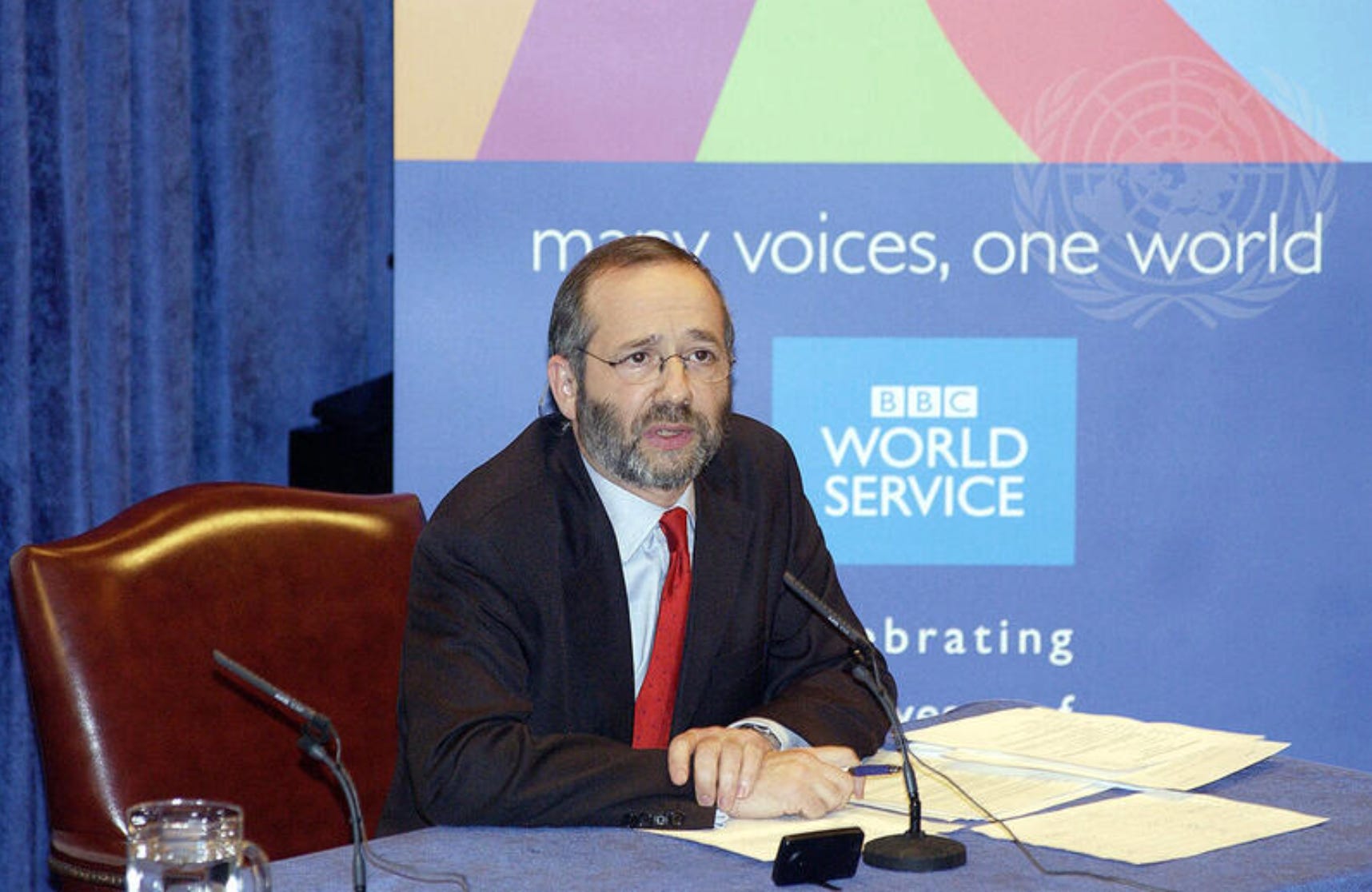
UN Photo: Mark Garten
It’s not a brand new tank, or a state-of-the-art attack drone, or a fancy fighter jet.
If we are serious about confronting the multiple threats that we face in this dystopian world of information warfare, deep fake videos and State-sponsored cyber attacks, our best, and most effective, defence is already at hand.
Just a click away, in fact. Click here to see what I mean.
Yes, it’s the BBC World Service, globally acknowledged for decades as setting the gold standard for reliable, impartial news coverage from some of the world’s most inaccessible places.
In December 2002, on the World Service’s 70th anniversary, I was at the United Nations headquarters in New York to hear the then UN secretary-general Kofi Annan describe it as ‘perhaps Britain's greatest gift to the world this century.’ (That’s when the photo at the top of this piece was taken — I’m afraid I’ve aged a bit since then.)
It was a unique accolade, but not undeserved. For hundreds of millions of people around the world, it is still an indispensable service, a light shining in some of the planet’s darkest places, a reliable, trusted voice from far away.
Yet now, unbelievably, its future is again at risk. In a speech last week, the BBC’s outgoing director-general Tim Davie sounded the alarm.
‘The current funding arrangement with the Foreign Office runs out at the end of March.’ he said. ‘Seven weeks today. We’re waiting to hear the outcome of the settlement.’
And as he pointed out, this deeply unsettling uncertainty comes at a time when ‘disinformation is flooding the digital sphere at an incredible speed, and state-backed media firms are using AI to promote propaganda. We have no time to lose.’
In January, as anti-government protests erupted in Iran, to be put down with appalling brutality and the deaths of perhaps tens of thousands of people, the BBC strengthened its output aimed at Iran and provided radio coverage on both short wave and medium wave. It was an invaluable lifeline at a time when government action had blocked virtually all access to the internet.
Some of my proudest moments as a journalist have come while I was broadcasting on the BBC World Service. I broadcast live commentary from Hong Kong in 1997 when the territory was handed over to China; I was on air the day Princess Diana, probably the best known woman in the world, was killed in a Paris car crash later the same year; and on 11 September 2001, I was back in Bush House to anchor endless hours of rolling news coverage after the most deadly terrorist attack of our times.
In April 2005, I anchored the BBC’s international coverage of the funeral of Pope John Paul II, and the very next day, I was back in the studio for the wedding of Prince Charles and Camilla Parker-Bowles. Each event, in its own way, was a major global story, and millions of people tuned in to hear coverage that they were confident they could trust.
None of which is to say that the BBC does not make mistakes. It is staffed by humans, often working under great pressure, so of course it makes mistakes.
Does it make more mistakes than it used to? Is it less trusted than it was in past? Perhaps, and not only because over the past ten years, the BBC’s income has been cut in real terms by something like thirty per cent.
Fewer editors, fewer checks, pared-back production teams. To say nothing of a media environment in which the President of the world’s most powerful nation talks endlessly of what he calls ‘fake news’ and is currently suing the BBC for $10 billion over a badly-edited speech for which the BBC has already apologised.
On Saturday, Keir Starmer said that Europe must be ready to fight to protect its people, values, and way of life. ‘We must build our hard power, because that is the currency of the age.’
What a shame he said nothing about soft power, because that — unlike hard power at a time when our armed forces have been stripped back to the bone — is still, despite years of budget cuts, something we’re rather good at.
(Ask people in the US what their most trusted news source is, and the BBC comes second only to the Weather Channel.)
Stephen Bush of the Financial Times put it well in his Inside Politics newsletter this morning: ‘What are the government’s methods for defeating the forces that attack Britain if they don’t involve spending far more on information warfare, of which high-quality, pluralistic journalism of the kind the World Service does is absolutely part for liberal democracies?’
Or, if you prefer, here’s The Guardian’s editorial from last Saturday: ‘No one doubts the World Service’s value as an instrument of soft power. But, as BBC bosses argue, it is also part of our national security. Accurate journalism is the strongest weapon in the war of information.’
Over to you, Prime Minister.
Depressing that this even needs to be said but thank you for saying it.
h/t Richard Woodcock